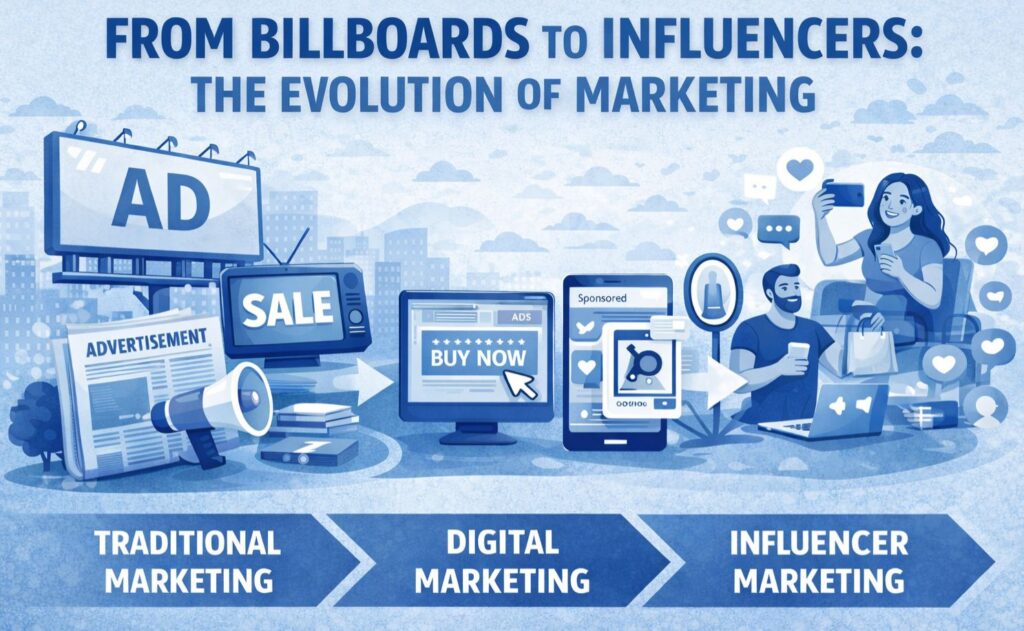
Marketing has always reflected how people live, communicate, and make decisions. As technology and society evolved, so did the ways brands reached audiences. The journey from towering billboards to social media influencers tells a larger story: a shift from one-way persuasion to relationship-driven engagement.
1. The Age of Traditional Advertising: Speaking to the Masses
In the early 20th century, marketing was built around visibility and repetition.
- Billboards, newspapers, and magazines dominated public attention.
- Radio introduced emotional storytelling through sound.
- Television later combined visuals, audio, and narrative, becoming the most powerful advertising medium of the time.
Brands controlled the message entirely. Consumers had limited choice and almost no voice. Success depended on how memorable and widespread a campaign was, not how relevant it felt to individuals.
2. Segmentation and Direct Marketing: Relevance Enters the Picture
As markets became crowded, brands realized that not everyone should be marketed to the same way.
- Direct mail, catalogs, and coupons targeted households based on age, income, or location.
- Telemarketing enabled limited interaction.
- Loyalty programs introduced early customer data tracking.
This era marked the beginning of consumer-centric thinking, though communication was still mostly one-directional.
3. The Digital Revolution: Power Shifts to the Consumer
The rise of the internet in the 1990s transformed marketing more than any invention since television.
- Websites became digital storefronts.
- Email marketing allowed fast, low-cost communication.
- Search engines introduced intent-based marketing—brands could reach consumers exactly when they were looking for solutions.
- Analytics enabled marketers to measure clicks, conversions, and ROI in real time.
For the first time, consumers controlled the journey: they could research, compare, ignore ads, or switch brands instantly.
4. Social Media: Conversation Replaces Broadcast
Social media changed marketing from campaigns into conversations.
- Platforms like Facebook, Instagram, Twitter, and YouTube allowed brands to interact directly with audiences.
- User-generated content, reviews, and comments became as influential as advertisements.
- Brand personality, tone, and values became visible—and judged publicly.
Trust was no longer built solely through polished ads, but through authentic engagement and responsiveness.
5.Influencer Marketing: Trust Becomes the Currency
As consumers grew skeptical of traditional ads, they turned to people they trusted.
- Influencers and content creators built loyal communities around shared interests.
- Micro- and nano-influencers often outperformed celebrities due to higher credibility.
- Marketing content became native, blending naturally into everyday social feeds.
This era blurred the line between advertising and recommendation. Consumers didn’t want to be sold to—they wanted advice from someone relatable.
6. The Present and Future: Personalisation, AI, and Community
Modern marketing combines data, technology, and human connection.
- AI and automation deliver personalized experiences at scale.
- Creator-led brands turn influencers into entrepreneurs.
- Values-driven marketing emphasizes sustainability, ethics, and community.
- Privacy and trust are becoming competitive advantages.
Marketing is no longer about selling products—it’s about building long-term relationships.
Conclusion
The evolution from billboards to influencers reflects a deeper transformation:
from broadcasting messages → to earning trust.
Today’s most successful brands listen as much as they speak, personalize rather than generalize, and build communities instead of audiences. As technology continues to evolve, the core principle remains unchanged: marketing works best when it connects with people, not just consumers.